Full-information NNE#
We provide an overview and code for the full-information Neural Net Estimator (full-info NNE), based on the paper “Estimating and Assessing Identification of Structural Models via Deep Learning.”
1. Overview#
NNE is an approach to estimate structural econometric models (e.g., discrete choice, consumer search, games). Let the structural model’s parameter vector be \(\boldsymbol{\theta}\). The basic idea is to train a neural net that can recognize the value of \(\boldsymbol{\theta}\) from data. The original NNE uses researcher-specified moments as input to the neural net. In contrast, full-info NNE frees researchers from specifying moments and uses the entire dataset as input.
The key challenge is that with a large input like an entire dataset, we typically must put a structure on the neural net architecture to make training feasible. Meanwhile, we want this architecture to be non-restrictive such that the neural net can still use all the information in data. It turns out that, when data have an i.i.d. structure (e.g., cross-sectional or panel), there is an architecture that allows us to achieve these two goals.
The full-information NNE is trained as follows.
Draw a value of \(\boldsymbol{\theta}\) from a prior. Given this value and the real-data product/consumer attributes, use the structural model to simulate a dataset.
Repeat the above step \(L\) times to obtain \(L\) pairs of values of \(\boldsymbol{\theta}\) and datasets. These pairs are our training examples.
Use the \(L\) examples to train a neural net with the “two-part architecture” to predict the value of \(\boldsymbol{\theta}\) from a dataset.
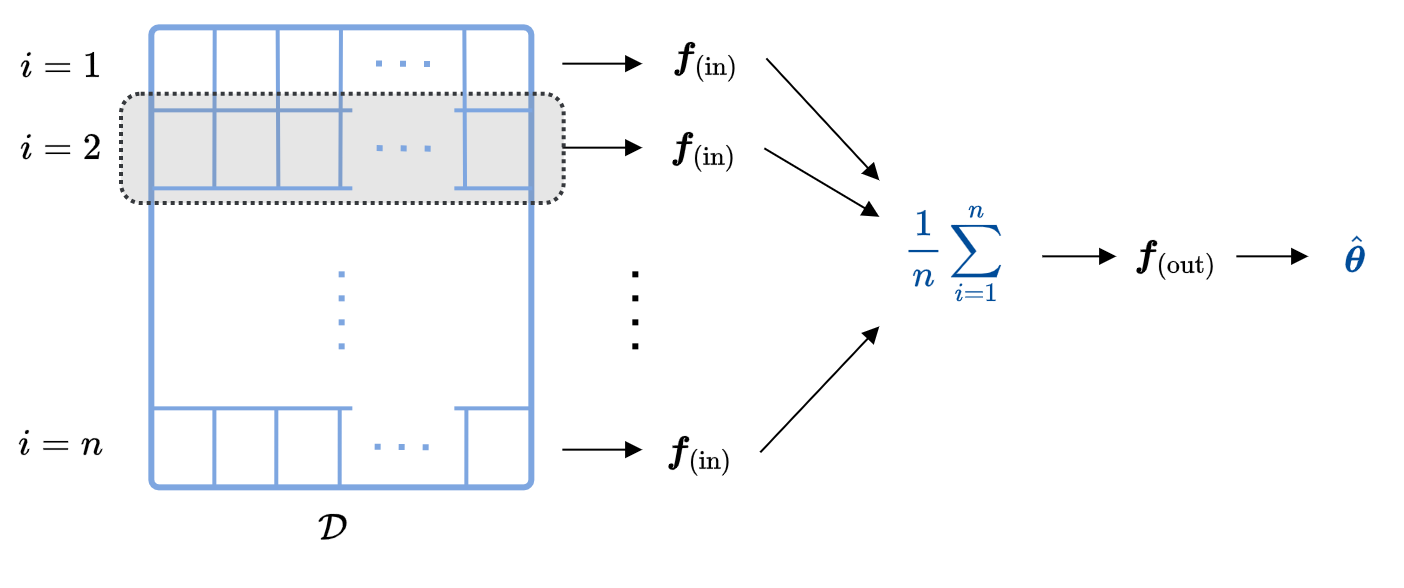
The “two-part architecture” first transforms each observation into a vector of features, and then uses the average features across observations to predict the value of \(\boldsymbol{\theta}\). Implementing this architecture is easy because it can be conveniently coded as a convolutional neural net (CNN). In the paper, it is shown that this architecture is not restrictive: the neural net converges to the full-information posterior mean of \(\boldsymbol{\theta}\) as we increase \(L\). The paper also shows how to train a second neural net to learn the full-information posterior variance.
2. Applications#
We provide Matlab code for two examples:
A mixed logit model. Because the likelihood for mixed logit is relatively easy to simulate, full-info NNE shows no advantages in accuracy or computation here. But this setting serves as a good example to illustrate how full-info NNE works in practice.
A search model with unobserved consumer heterogeneity. This example shows the accuracy and computational advantages of full-info NNE.
You can find the code at this GitHub directory, and code documentation at the mixed logit model page and the search model page.